
Quick Summary (TL:DR)
Understanding Generative AI and Foundation models is critical to unlocking AI’s value while avoiding risks around accuracy, bias, and data security.
As enterprise AI adoption accelerates, a new set of technology terms has entered the mainstream. These buzzwords aren’t marketing fluff—they reflect real architectural shifts in how organizations think about data, security, governance, and AI at scale.
Understanding these concepts is critical for companies—especially in data-intensive industries like oil and gas—looking to adopt AI responsibly and sustainably.
Below are several of the most important terms leading-edge technology teams are paying attention to today, the critical challenges and questions behind them, and why they matter.
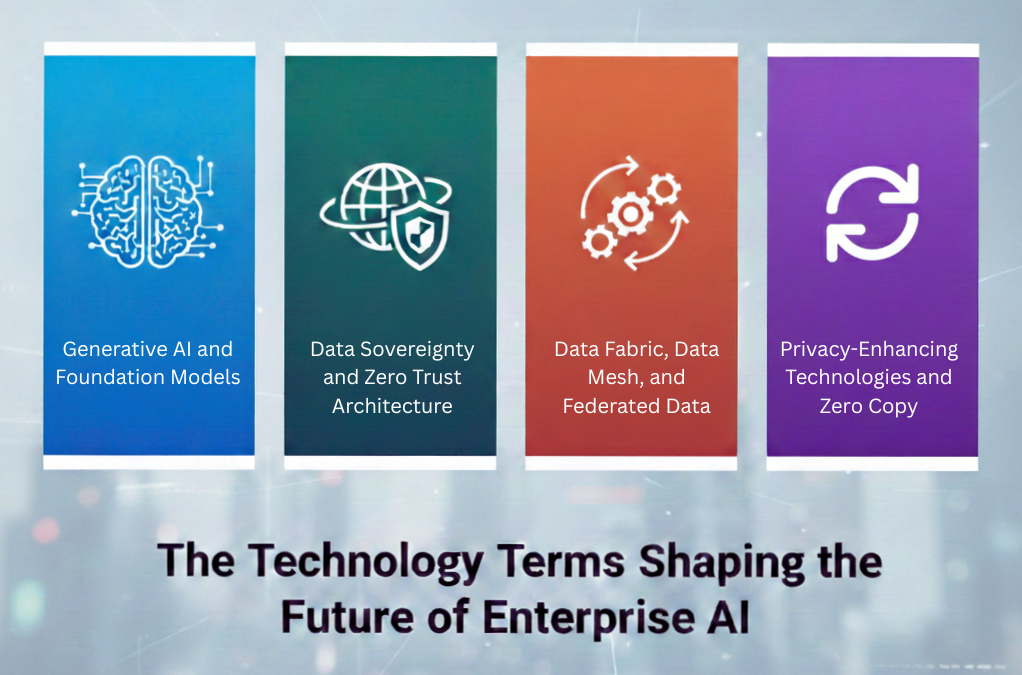
Generative AI and Foundation Models
Generative AI and foundation models refer to large, pre-trained models capable of reasoning, summarizing, and generating content across many domains. Their power comes from scale—but that same scale introduces challenges around accuracy, governance, and trust.
What are the main challenges in using generative AI and foundation models safely in enterprises?
Answer: The biggest enterprise concerns include: ensuring accuracy (avoiding “hallucinations”), managing bias and ethical issues, protecting sensitive data and privacy, integrating with existing systems, and establishing governance and trust frameworks so outputs are reliable and compliant.
For enterprises, the focus is shifting from “Can we use GenAI?” to “How do we use it safely on our own data?” Platforms like ChatWDL are designed to sit on top of these models and make them usable in enterprise workflows without exposing sensitive information.
Data Sovereignty and Zero Trust Architecture
Data sovereignty ensures data remains under the control of the organization that owns it—both physically and logically. This has become especially important as AI platforms increasingly rely on cloud-based services.
What’s the biggest challenge in implementing GenAI while maintaining data sovereignty?
Answer: Most GenAI tools require copying or sending data outside your controlled environment. Sovereignty requires keeping data where it already lives. ChatWDL can deploy AI agents that exist in your existing data environments.
Zero Trust Architecture complements this by assuming no system or user should be trusted by default. Every interaction is authenticated, authorized, and logged.
Modern AI platforms must align with these principles by respecting existing access controls, audit trails, and governance policies—rather than bypassing them.
Data Fabric, Data Mesh, and Federated Data
Enterprises rarely have a single source of truth. Data fabric and data mesh architectures acknowledge this reality by allowing data to remain distributed while still being accessible in a consistent way.
This is where federated data access becomes essential. Instead of centralizing data, AI systems query it where it lives. This approach reduces duplication, improves security, and accelerates adoption.
Why is federated data difficult for AI initiatives?
Answer: AI needs context and consistency, but federated environments create fragmentation and semantic gaps.
Why can’t we just centralize all federated data?
Answer: Centralization is expensive, slow, and often blocked by sovereignty, compliance, or operational constraints.
ChatWDL is designed to operate within these federated environments, allowing AI agents to work across multiple data sources without forcing large-scale data migration.
Privacy-Enhancing Technologies and Zero Copy
With increasing scrutiny on how AI systems use data, privacy-enhancing computation and zero-copy architectures are gaining traction.
Zero Copy means data is analyzed in place—without being copied, stored, or used to train external models. For organizations handling proprietary or regulated data, this provides peace of mind while still enabling advanced analytics and AI-driven insights.
Rather than being a universal requirement, zero-copy capabilities are increasingly viewed as an important option within enterprise AI deployments.
How can we deploy GenAI without moving our data?
Answer: Advanced solutions, such as ChatWDL have the ability to deploy a zero-copy architecture that queries data in place rather than ingesting it, ensuring data sovereignty for enterprise companies.
From Buzzwords to Practical AI
While these terms often show up as buzzwords, they represent real shifts in how enterprises deploy AI:
- From centralized to federated data
- From blind trust to zero trust
- From experimentation to governed production systems
The goal isn’t to adopt every trend—it’s to understand which concepts align with your organization’s data strategy, security posture, and long-term goals.
By grounding AI initiatives in these principles, companies can move faster without sacrificing control, and platforms like ChatWDL help bridge the gap between cutting-edge AI capabilities and real-world enterprise requirements.
